

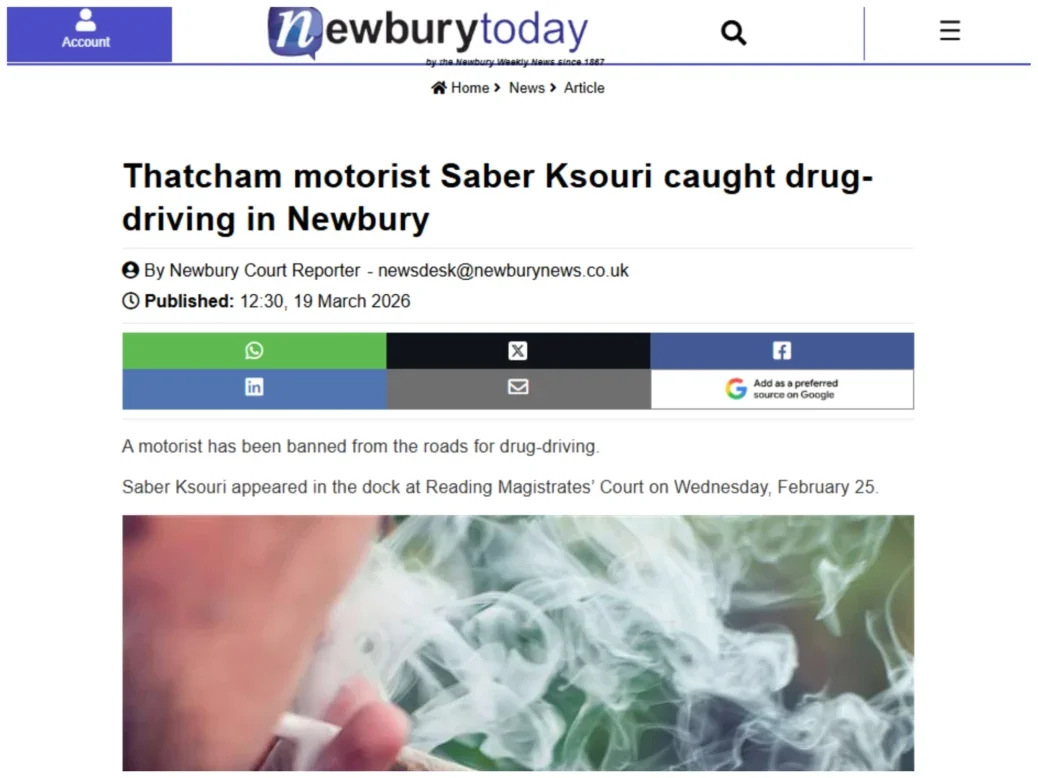
Facebook has restricted a UK local newsbrand from monetising its content or reaching new people on the platform after it posted a court story about a drug-driver.
Newbury Today, owned by Iliffe Media, has had restrictions on its Facebook page for almost two months and has not been able to get any response from parent company Meta.
The issue began on 19 March when a Newbury Today journalist posted a court story about a motorist being sentenced for drug-driving, in line with their usual practice for sharing articles.
The story and post were both illustrated by a stock image of a man smoking a cannabis joint.
The post was removed because, Facebook said, it “may buy, sell, promote or exchange illegal or restricted drugs.
“This goes against our Community Standards.”
Sarah Bosley, Iliffe’s group editor for Newbury, New Milton and Stratford, acknowledged that “with hindsight the picture is probably not the best one to have used and we wouldn’t use it again”.
“The rule that it says it broke is ‘promoting drug use’. It’s obviously not. It’s the complete opposite. It’s a story about a person who’s been charged and sentenced for drug use.”
An appeal against the decision was rejected and there has been no response to an escalation to Meta’s oversight board (whose members include former Guardian editor Alan Rusbridger), which acts as an independent body to check the company’s content moderation decisions.
Because the page has been found to breach Facebook’s community standards, Newbury Today is no longer allowed to monetise engagement with its content under a scheme introduced last year.
Bosley told Press Gazette the page had only joined the monetisation scheme in recent months and March was on track to be its best month yet before it was switched off.
Facebook has also put restrictions on Newbury Today’s page meaning it is no longer getting recommended to users who have not already followed it but who might like the content due to their other activity on the platform.
As a result, views to Newbury Today content on Facebook in the first week after the restrictions began were down 45%, according to Bosley.
She added that there had been a “knock-on effect” to website page views as “the stories just aren’t getting out there at all”.
She said Newbury Today has a “healthy” Facebook following of 36,000 people “but we’re just not getting anyone new”.
Bosley said this was bad from both a business point of view but also in terms of getting stories out to people in an area with no other locally-based news source.
“It’s scary how much of an impact one company can have… we are looking at other ways to get our stories out.”
Another Iliffe Media brand, Kent Online, spent a week last year with its presence on the Facebook news feed restricted, resulting in referral traffic from the platform to the website falling by about 48% week on week.
That restriction was put in place after a link to a court story about the alleged rape and sexual abuse of a child was posted.
A Facebook page for Kent Online sister brand KMFM was also temporarily taken down for a “breach of community standards” after it posted a different court story about a sex offender who used the dark web to make indecent images of children.
And the admin account for independent publisher Leicester Gazette was disabled days before last year’s local elections after being told it “doesn’t follow our community standards on account integrity”. Facebook described this as an “error” after Press Gazette got in touch.
Other independent publishers globally have reached out to Press Gazette in the past year to say they had similar issues with Facebook, suggesting it is a wider and ongoing issue.
In the UK, Facebook will soon have to follow new rules under the Online Safety Act meaning it must notify news publishers if it plans to take action against any of their content and give them an opportunity to make representations.
This would cover taking down news publisher content, restricting users’ access to their content or adding warning labels (unless these are only shown to children).
The rules will be enforced by Ofcom, which plans to consult on the rules between July and September and have them in place by mid 2027.
They will cover services classed as ‘Category 1’, meaning either that a platform uses a content recommender system and has more than 34 million UK users, or that it lets users forward or reshare user-generated content, uses a content recommender system, and has more than 7 million UK users.
Facebook looks likely to be covered by this definition but Ofcom has not yet concluded the categorisation process due to a legal challenge from Wikipedia, which the website lost, last year.
Meta has not responded to a request for comment.
Email pged@pressgazette.co.uk to point out mistakes, provide story tips or send in a letter for publication on our "Letters Page" blog
